|
SOIL AND GROUNDWATER REMEDIAL DESIGN
Soil and groundwater remediation and cleanup may be required
to facilitate development of land for residential, commercial/industrial,
or other land use. Soil cleanup may also be required to mitigate impacts
for existing land use, or to mitigate impacts to groundwater and/or surface
water. Groundwater remediation may be required to reduce concentrations
of various compounds below regulatory agencies specified threshold levels
or to prevent the potential impact on a receptor such as a stream or drinking
water well. The following summarizes some of the methods applied by ART
to remediate soil and groundwater:
Excavation and Disposal/Treatment
Typically the “baseline” for soil remediation, ART
will often remove contaminated soil through excavation and then transport
it off-Site for disposal at a landfill. As part of excavation projects,
ART can develop the planning documents required by regulatory
agencies. These documents include grading plans, air quality monitoring
programs, health and safety plans, storm water pollution prevention plans
(SWPPP), and comprehensive sampling plans.
Soil Vapor Extraction
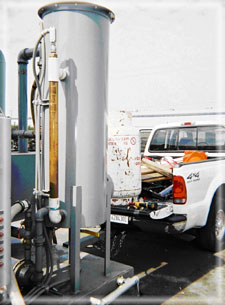
Volatile compounds, such as gasoline and solvents, can be remediated through
vapor extraction. Wells installed in the vadose zone are used to apply
a vacuum and extract volatile vapors from the subsurface.
Dual-Phase Extraction
This technology involves the extraction of groundwater to lower water
levels within a well, and then vapor extraction to remove volatile vapors
from the dewatered sediments. The technology can be effective for volatile
compounds such as gasoline or solvents in tightly compressed soils.
In-Situ Chemical Oxidation
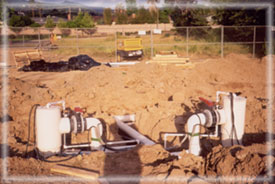
This technology involves injection of chemical oxidants such as peroxide,
ozone, or permanganate into the soil and groundwater to facilitate chemical
transformation of contaminants. The technology is suited well in situations
where chemicals are recalcitrant to biodegradation, either due to their
chemistry and the aquifer conditions or due to elevated chemical concentrations.
Chemical oxidation can be used for solvent and hydrocarbon contamination,
and can be favorable when significant concentrations of contaminants are
present that will prevent successful bioremediation. Chemical oxidants
can be injected into the subsurface using Geoprobe borings and injection
wells.
 In-Situ
Chemical Reduction In-Situ
Chemical Reduction
Contaminants in the subsurface can also be remediated through chemical
reduction. An example is hexavalent chromium, which can be reduced in-situ
to the less toxic and less soluble trivalent chromium precipitates. Chemical
reduction is done through injection of compounds such as sodium thiosulfate,
calcium polysulfide, and ferrous sulfate.
In-Situ Bioremediation/Biodegradation
In-situ bioremediation/biodegradation is commonly the most cost-effective
means for treatment of soil and groundwater impacted by contaminants.
It involves the natural degradation of chemicals as result of aerobic
and/or anaerobic processes. Even metals can be treated by stimulating
microbial activity in the subsurface. Although most contaminant plumes
are undergoing bioremediation naturally, injection of materials into the
subsurface may be necessary to accelerate the process. In some cases,
natural bioremediation/biodegradation may be stalled because one or more
limiting elements, such as oxygen, nitrate, and sulfate, have been completed
exhausted by the microbial population. The oxygen is paramount for aerobic
degradation, and the nitrate and sulfate for anaerobic processes. Materials
such as ethanol and essential nutrients can be injected into the subsurface
to facilitate natural remediation of chemicals in soil. Oxygen may also
be introduced to through various mechanisms including sparging and oxygen
release compound (ORC). Nitrate, sulfate, and other key elements for anaerobic
degradation are usually injected in solutions.
Hydraulic Control
Experience has shown that little contaminant mass is typically removed
using groundwater extraction, and thus pumping groundwater is used primarily
today for hydraulic control in cases where contaminants are migrating
off-site at unacceptable rates. ART has experience designing,
installing, and operating hydraulic control systems. The design typically
involves aquifer testing and numerical modeling. The system operation
will include extraction wells, conveyance piping, and potentially above-ground
treatment. Treated groundwater is either discharged under appropriate
permit to a sewer system, storm drain, or surface water, or re-injected
to the aquifer.
Natural Attenuation
Natural attenuation is the collective term for the various processes,
like sorption, dilution, dispersion, and natural biological degradation,
whereby contaminants are prevented from spreading in the subsurface. Due
to the high costs to remediate chemicals in the subsurface to their low
remedial goal concentrations, most remedial programs involve natural attenuation
to some degree. In some cases, natural attenuation may the primary remedial
measure selected. In other cases, natural attenuation is selected as the
final remedial option following completion of more aggressive measures
such as source removal and hot spot groundwater cleanup. Approval of natural
attenuation remedial measures by regulatory agencies typically requires
evaluation of the Site to demonstrate a thorough understanding of hydrogeology,
contaminant distribution, and contaminant fate and transport. Fate and
transport analysis may require modeling and risk assessment. Long-term
monitoring
 REMEDIAL INVESTIGATION
|



 REMEDIATION
SERVICES
REMEDIATION
SERVICES